
Embroidery vs Screen Printing: Which One to Choose for Custom Clothing?
Embroidery or screen printing for custom clothing? Compare costs, durability, appearance and order sizes to choose the right method for your business.
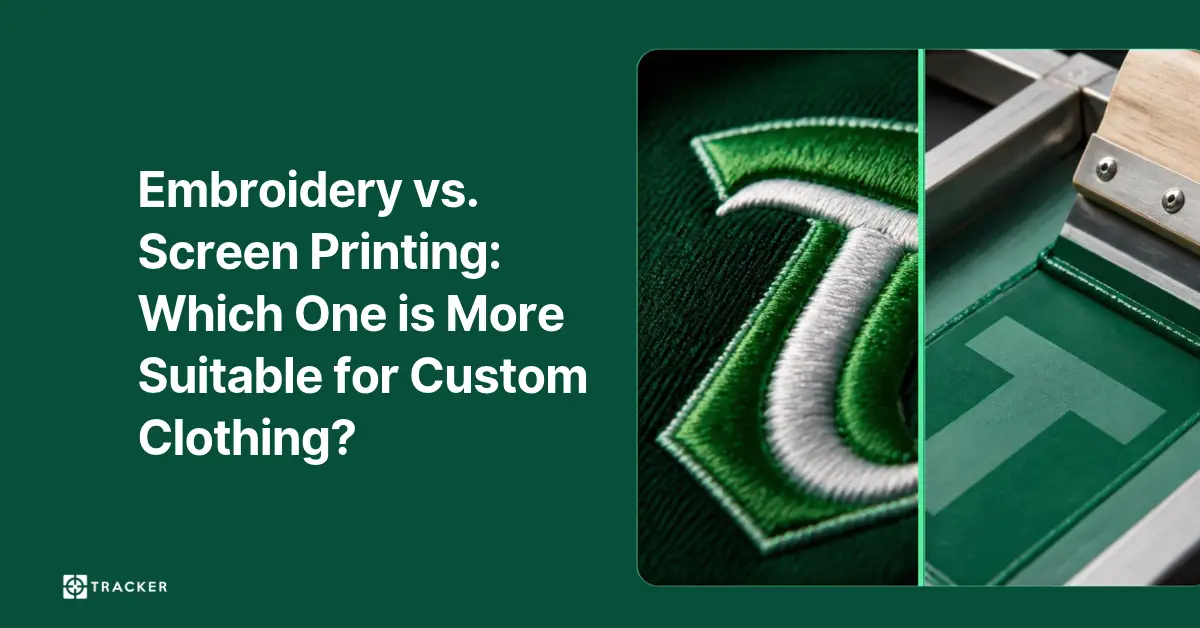
Embroidery is best for small logos, staff names, and textured branding on structured garments like polos, caps, and jackets. Screen printing is far better for large, full-colour graphics, gradients, and high-volume orders on T-shirts and hoodies. Most decoration shops run both methods side-by-side depending on garment weight, run size, and artwork complexity.
When it comes to custom clothing, embroidery and screen printing are the prime candidates, but they work better for different applications. In fact, when it comes to small logos placed on polo shirts, embroidery is usually the first method we look at. If the design covers most of the back of a T-shirt or hoodie, screen printing makes far more sense.
That is why there is no useful answer to “which is better?” without looking at the garment and the artwork first.
In production, we usually take into account the following factors: the size of the design, the amount of detail involved, the type of fabric used, how the garment will be worn, and the number of pieces to be produced. Evaluating these factors gives far more practical direction than simply debating decoration methods in the abstract.
In this blog post, we will explore the key differences between embroidery and screen printing, comparing their production workflows, costs, and exactly when you should choose each method.
Embroidery vs Screen Printing: A Quick Comparison
The basic difference between these two methods is straightforward: while embroidery employs threads to construct the design into the fabric, screen printing pushes ink through a mesh screen onto the clothing.
| Factor | Embroidery | Screen Printing |
|---|---|---|
| Best suited to | Logos, names and smaller branding | Larger graphics and expansive print areas |
| Finish | Raised, textured, three-dimensional | Flat, smooth printed finish |
| Common garments | Polos, jackets, fleeces, caps, heavy workwear | T-shirts, hoodies, sweatshirts, tote bags |
| Small lettering | Constrained by stitch thickness & digitising | Highly crisp and flexible down to fine point sizes |
| Large designs | Can become heavy, stiff, and expensive | Extremely cost-effective and comfortable |
| Durability | Excellent on structured garments | Very durable when cured and printed properly |
| Setup | Artwork must be digitised into stitch files (DST/EMB) | Screens and colour separations required |
| Large runs | Scales well with multi-head machinery | Exponentially faster per-unit cost reduction |
| Typical use | Corporate uniforms, hospitality, trade workwear | Band merch, promotional tees, retail clothing |
How Does Embroidery Work?
A regular logo image file is not directly compatible with an embroidery machine in the way that it is with an office printer. The essential first step is to digitise the artwork.
In the digitising process, the logo is converted into a stitch file. The format depends on the embroidery software and machine system being used, typically resulting in a DST or EMB file. This file controls how every stitch is laid down, including stitch direction, density, thread colour changes, underlay structure, and sequencing.
This step plays a critical role in the final outcome:
- Small details: A logo with a strapline underneath might look crisp on a high-res monitor, but once scaled down to chest size, the lettering may be too small for needle and thread. Counters close off, thin lines disappear, and the text becomes illegible.
- Garment structure: A dense, heavy logo might sew beautifully onto a 220gsm pique polo, but it will pull, pucker, and distort a lightweight 140gsm cotton T-shirt. Stabilisers and backings help, but fabric limits cannot be ignored.
To produce clean embroidery, the digitiser and production team must apply experienced judgment before the job reaches the machine. It is always better to adjust a tiny detail in the artwork upfront than to sew a distorted result across a hundred garments.
How Does Screen Printing Work?
The screen-printing process begins with pre-press artwork preparation. For spot-colour printing, the artwork is broken down into colour separations, with each colour exposed onto its own emulsion-coated mesh screen.
During production, ink is pushed through the stencil openings onto the garment using a squeegee. When multiple colours are involved, the printer registers each screen with high precision, applying each layer in sequence.
The most critical step follows printing: ink curing.
Proper curing is vital. An ink layer may look vibrant and flawless right off the press, but if it hasn’t spent sufficient time at the correct cure temperature in the dryer, the ink will crack, peel, or wash out prematurely. Longevity in screen printing comes down to proper ink chemistry and dryer calibration.
For dark garments, an opaque white underbase screen is printed and flash-cured first so the top colours remain bright. While screen printing requires more upfront setup time, once the press is dialed in, it produces garments rapidly, driving down the unit cost on volume orders.
Your Artwork Often Makes the Decision
When clients ask whether they should choose embroidery or screen printing, the artwork is usually the first factor that determines the answer.
Clean, bold logos with legible lettering and a handful of distinct colours are ideal for embroidery. Expansive designs featuring photorealistic elements, halftones, gradients, or intricate line work are natural candidates for screen printing.
Small Text
Because embroidery thread has physical thickness, lettering below 4–5mm in height quickly loses clarity. Fine script fonts and delicate serifs are especially challenging to sew cleanly. Screen printing, by contrast, can reproduce remarkably fine text and sharp lines without loss of detail.
Large Filled Areas
A large, solid graphic sewn in embroidery requires tens of thousands of stitches. This dramatically increases machine run time, consumes massive amounts of thread, adds noticeable physical weight, and creates a stiff “bulletproof” patch on the garment. For large front or back designs, screen printing is by far the superior choice.
Gradients and Fine Detail
While experienced digitisers can blend thread directions for shading effects, embroidery cannot achieve smooth continuous-tone gradients. Screen printing easily accommodates subtle shading, photographic elements, and multi-colour blends through halftone dot screens.
Which Garments Are Most Suitable for Embroidery?
Embroidery performs best on garments with sufficient structural integrity to hold stitches under tension:
- Polo shirts: The woven pique texture provides a stable foundation, and the classic embroidered chest logo matches corporate and casual dress codes.
- Fleeces, jackets, and softshells: Thick outer layers absorb stitch density effortlessly without puckering.
- Caps and beanies: Embroidered headwear is durable and premium; however, curved cap frames require proper digitising around centre seams.
- Workwear and aprons: Heavy-duty cotton drills and polycotton blends withstand industrial washing and heavy embroidery.
Lightweight T-shirts can be embroidered, but designs should be kept small and light to avoid puckering the fabric.
Which Garments Are Most Suitable for Screen Printing?
Screen printing thrives on smooth, flat surfaces where ink can bond cleanly:
- T-shirts: The smooth face of combed ring-spun cotton allows ink to lay flat and soft.
- Hoodies and sweatshirts: Large fleece surfaces provide the perfect canvas for oversized chest prints and full back graphics.
- Promotional apparel: Screen printing offers the lowest cost per unit for high-volume event shirts, marathon tees, and band merchandise.
- High-visibility & trade wear: Bold company names, phone numbers, and safety graphics on trade wear are quickly applied with screen printing.
Fabric composition must be noted: 100% cotton cures predictably, whereas 100% polyester athletic wear requires low-cure or bleed-resistant inks to prevent dye migration.
Embroidery and Screen Printing: Which Is More Durable?
Embroidery is renowned for exceptional lifespan. Because the threads are sewn directly into the fibres of the fabric, a quality embroidered logo will often outlast the garment itself, enduring hundreds of commercial laundry cycles without fading.
Screen printing also offers outstanding durability when properly cured. High-quality plastisol or water-based inks on well-prepped garments will withstand years of regular washing without cracking or peeling.
However, durability alone shouldn’t dictate your choice. Stitching a 30cm back design purely because thread “lasts longer” will result in a stiff, unwearable shirt. Match the method to the design and garment first.
Embroidery vs Screen Printing: Cost Comparison
The cost structures of the two methods operate very differently:
- Embroidery pricing: Driven by stitch count and machine running time. A 4,000-stitch chest logo sews much faster than a 15,000-stitch design. Digitising incurs an initial one-off setup fee, but the file can be reused indefinitely on future reorders.
- Screen printing pricing: Driven by setup and colour count. Every colour requires a separate screen, film separation, and press setup. While upfront setup makes small orders (under 24 units) expensive per unit, higher volumes (50–500+ units) drop the per-shirt price dramatically.
Embroidery or Screen Printing: Which for Workwear?
Many businesses combine both techniques across their company workwear packages:
- Embroidered logos on the left chest of polos, softshell jackets, and fleeces create a professional, polished appearance for customer-facing staff.
- Screen-printed bold graphics and contact details on the back of work T-shirts and hoodies ensure high visibility on job sites.
- Individual staff names are easily embroidered above pockets or on sleeves.
There is no need to restrict an order to a single technique when each garment serves a distinct functional purpose.
When to Choose Embroidery
Choose embroidery when:
- You need a small, premium left-chest or sleeve logo.
- The garment is structured: polo shirts, jackets, fleeces, caps, or aprons.
- You are producing corporate uniforms, trade workwear, or hospitality apparel.
- Individual staff names or personalisation are needed.
- Long-term wash durability on heavy-use uniforms is top priority.
When to Choose Screen Printing
Choose screen printing when:
- The design features large artwork, full-front graphics, or oversized back prints.
- You are decorating lightweight T-shirts, hoodies, or tote bags.
- You are producing event merch, band merchandise, or promotional giveaways.
- The artwork includes intricate details, small typography, or halftone gradients.
- Order quantities are medium to large (24–500+ units), maximizing volume discounts.
Can Embroidery and Screen Printing Be Used Within One Order?
Yes! Decorators frequently combine both processes in a single job. A customer order might specify embroidered polos for management and screen-printed T-shirts for warehouse staff. Similarly, hoodies can feature an embroidered chest crest paired with a large screen-printed back graphic.
Combining decoration methods delivers the best aesthetic and ergonomic result for the wearer while optimizing costs for the customer.
How Tracker Can Help
Managing orders that span multiple decoration processes can quickly become complicated without unified tracking:
- Centralised Logo Management: Tracker’s logo management stores vector art, digitised DST/EMB stitch files, colour specifications, and customer approvals together. Your operators will never run the wrong file revision or sew an outdated proof.
- Unified Production Scheduling: Tracker’s production scheduling software lets you schedule embroidery heads and screen presses side-by-side. You can see real-time machine capacity, track multi-process job progress, and ensure both parts of an order meet the packing table simultaneously.
- Streamlined Proof Approvals: Generate clear digital proofs displaying mockups, stitch counts, and print dimensions for customer sign-off before production starts.
Ready to optimize your decoration shop floor? Book a demo with our team or learn more about getting started.
Final Thoughts
Neither embroidery nor screen printing is universally “better”—they are complementary tools in a modern decoration shop. Small logos on structured workwear, polos, and headwear naturally suit embroidery, while bold, expansive graphics on tees and hoodies belong on a screen press.
When a project sits between the two, evaluate the stitch count, artwork detail, fabric weight, and order quantity. By choosing the right method for each specific item, you ensure premium quality for your customer and maximum efficiency on your shop floor.
Will Hemming
Founder & Technical Director
Related Articles
Understanding Screen Printing vs. DTG: Which is Right for Your Business?
A comprehensive comparison of screen printing and direct-to-garment (DTG) printing to help you choose the right technology for your specific business needs.
Read More
What is DTG Printing? A Beginner’s Guide for Decoration Shops
Learn what DTG printing is, how it works, its benefits, costs and limitations, and how decoration shops can use it for custom apparel printing.
Read MoreSubscribe to Our Newsletter
Get the latest articles, product updates, and workflow tips delivered straight to your inbox.
By subscribing, you agree to our Privacy Policy and consent to receive updates from our company.